Monday, June 28, 2010

Nyon - Sights, Chateau Up and Rive-side Down

 The Sights of Nyon

Nyon, you have a lovely castle.

This is a small chateau town.  In the 13th Century, Counts of  Savoy began building their castles, and the one here is built atop Roman ruins.  See ://www.myswitzerland.com/en/destinations/resorts/holiday-destinations-in-switzerland/nyon.html/ 


Start uptown, for the view,


 At Yverdon-les-Bains, where there is another Savoy castle, we learned that the Savoys liked the square format, and some calling it the Savoy Square. The shape lends itself to various performing arts events.


No-one could easily creep up unseen at this towering site. Now there are nice walkways.


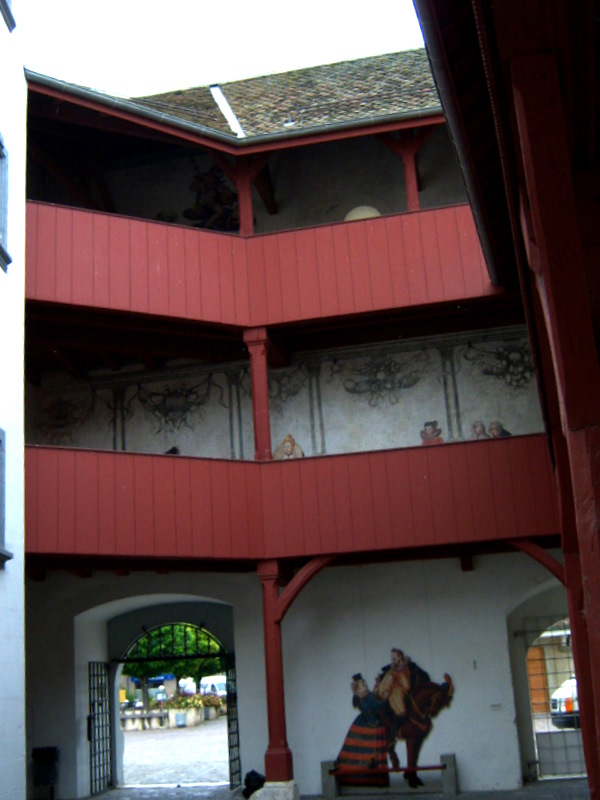
This is a nearby large house (when does it become a chateau?), see it to the left of our top photo, where the eye immediately goes to the Chateau de Nyon, all white. Time for this one to come out of the shadows. Not everyone has replastered and whitewashed.  Good.  We like the ones that show some age.

Get a full walk-around show on Nyon and its streets and buildings at ://www.dpeck.info/nyon1.htm/


Take the elevator down.


You can also walk the winding way back down to the riverfront area, the Rive. That is where our little hotel was, bless it.

Look closely as you walk the rest of the way to the riverfront, and find Roman ruins - there, a structure, a part of wall. Some columns. Julius Caesar established the colony here and called it Noviodunum,  after he had finished with his conquest of Gaul.


Nyon - Lake Geneva. Respite Spot Yes and Not

 NYON

The town of Nyon is on Lake Geneva, between other major destination points: Geneva itself, and Lausanne. If you landed at Geneva, and are in your rental car after a long night flight, Nyon is probably too close for a stop. You may want to just drive a while. So use Nyon for your overnight on the way back to Geneva from Yverdon-les-Bains or Murten, on the way out. Who wants to go into a big city in the late afternoon.


See crew shells on the Lake, with the castle and a ferry in the background.

People fish from the rocks by the shore, on the promenade past at the Rive area of town.


You may end up in a room like Guantanamo, however.


And still pay dearly for it - because you left the looking for a room so late ... yes, it is that narrow. Aargh. For that price??


Narrow room in Nyon. But the bawth was clean, as was the room, so chalk it up.


Nyon. Prepare also to be taken.

Scamtime. Switzerland is no different from anywhere else, including the US when it comes to taking advantage of passers-through, but prepare for this one:  an entrepreneur swipes your card, says --uh-oh -- not going through, tsk tsk.  We'll just have to try it again, and swipe.  Still no good, says he.  So you go to an ATM for the cash needed for what you want, no problem, and in the morning they say -- lucky us, the card went through! So you sign for what you had not paid for before, but when you get home, you see the items you paid cash for, added to your not-so-fritzed card.  Luckily, ours were minor.

Sunday, June 27, 2010

Yverdon - les - Bains - Castle, Baths, Mummies, Celts and Romans,

 Yverdon-les-Bains
Yverdun *
.
At the southern end of Lake Neuenberg (Murten is to the northwest), is an old spa town with surprises in its castle.  See http://www.texetera.ch/english/testimonials/historic-buildings/yverdon-castle/ Listen to part of the audio guide there.  "Dun" or a variant of that means fort, or hill fort, from Celtic times.* Find romance also. The chapel at Savoy's castle is still used for weddings. See http://www.isyours.com/e/guide/arc_jurassien/yverdontown.html
.
.
Yverdon still is a spa town. Go ahead: find a venerable tub and submerge, partially. Les bains - the baths. Thermal spa, sulphur water, magnesium; come here for healing.  People have for 6000 years. There is some therapeutic value to the soaking, but not the mystical scope as once believed, see ://www.wwdmag.com/Sulphur-Water-Solution-article3130/ Relax, revitalize, let impurities begone.
.


.
Now think of the poultices and remedies you might try.
.
This old Savoy Castle houses a manageable museum, that includes geographical and geological exhibits. We like the more modest museums.
.
At this nice spa town, however, prepare to meet the grave-robbers from centuries ago and not so long ago, and gaze upon the fruits of their labors. Mummies apparently were quite the rage, see http://www.mummytombs.com/  The Yverdon mummy story is at http://www.musee-yverdon-region.ch/musee.php?include=collections&lng=en/  The artifacts date from the Ptolomaic era and are highly regarded by those who follow these things.
.
.
Why mummies here?  Mummies and healing. Use their parts, or grind their parts into a powder. Stir. Mix the powder from the ground mummy with honey and/or wine, apply it as a poultice or drink up.   Mummies were believed to have healing qualities, see http://www.swissinfo.ch/eng/index/Castle_reveals_secret_of_severed_hand.html?cid=4109604/.  There was a market for parts. Find the history of the travels of a specific mummified hand at Gruyeres castle.  
.
A Napoleonic expedition in the late 1700's got everyone interested and the craze began. Taking mummies was illegal, so parts were used. Parts were more easily smuggled, but clearly others found their way intact, across and into Switzerland and elsewhere. 
.
.
The Swissinfo site says tar was used for embalming. 


Smithsonian, however, describes a drying process preventin decay by using four salts found at the Nile, the combination known as natron.
. Palm  wine disinfected, frankincense perfumed.  See article by Owen Edwards at http://www.smithsonianmag.com/arts-culture/How-One-Mummy-Came-to-the-Smithsonian.html
.
Even this site says he looks rather homesick  http://www.isyours.com/e/guide/arc_jurassien/yverdontown.html/.
Can we let him go home now?

The museum also features archeology, particularly Celtic artifacts.
.
.
And there is a collection of intricately carved furniture.


.
I have a vague recollection that this was this a chamber pot chair, where you lift the seat and sit.  No, perhaps not. Fancy chamber pot chairs usually have a panel at the front concealing the pot. 
...........................................................
.
.
Noviodunum has become the town of Nyon.

Saturday, June 26, 2010

Frauenparkplatz; and Where the Buffalo Roam

 Murten and Wise Parking Arrangements

Avoid parking where you must anticipate your time away. Ticketing, and hiding the pay-go ticket machine around the corner so you think the parking is ok on the street where you are (NOT!) is, as here, a favorite municipal pastime.  Lots cost more, but you can enjoy your lunch.

Frauenparkplatz in Murten.  Ladies-only parking. A common-sense safety courtesy:  In Murten's facility, ladies can park cozily on the first level, at the street entrance, lots of lighting and a chance of people around.  With our Sir Daniel Galahad along, however, we happily spiraled downward instead. For any parking garage safety and efficiency in car-retrieval, write down your parking level and identification. Or take a picture at your level and spot and delete it when you don't need it. Before getting in your car, check under and all around, quick in and lock. As anywhere. Walk noisily so you do not surprise someone doing what some do.


Roll down the window and inhale. Aah.  No parking fumes.  But, what the?

Egad!


Les Buffalo! 

These are not the water buffalo whose milk has a high fat content and is added to some Swiss mozzarella cheese varieties, see ://www.nytimes.com/2006/06/12/world/europe/12swiss.html/.  These are the USA western plains variety.  Is their milk also used for cheese?

Known:  Their rumps make a nice salted meat product, and those and other parts provide variety steaks and burger, see http://www.sciencedirect.com/science?_ob=ArticleURL&_udi=B6T9G-3YCV00N-B&_user=10&_coverDate=04%2F30%2F2000&_rdoc=1&_fmt=high&_orig=search&_sort=d&_docanchor=&view=c&_searchStrId=1382446832&_rerunOrigin=google&_acct=C000050221&_version=1&_urlVersion=0&_userid=10&md5=09b38e163f53418765a23f761044d3d4/.  

Salted buffalo rump? Air-cured. Bresaola. A new Swiss industry.  From its Italian roots to the Swiss, see ://www.wisegeek.com/what-is-bresaola.htm/


Inhale? Are you kidding?


Very fine milk, too.

Friday, April 23, 2010

Murten's Churches - Catholic, Protestant

There are two main churches in Murten: a Catholic, Late French Gothic (about 1478), and a Baroque Protestant German Church about 1710, the Deutsche Kirche (no surprise there).

Find a history of protestantism in Germany and Switzerland at ://www.isyours.com/e/guide/religion/christianism/protestantism.html/  In this town, they coexisted.  The Zurich theologian, Zwingli, shared the same motivations as Martin Luther, says the site.

In investigating old churches, watch in the later ones for the influx of ordinary people, bodies, faces.  It looks like the 1400's marked a change: regular folk replacing the saints, that had peopled the churches in the centuries before the 1400's or so.  Individual expressions, tastes on clothing, headwear.  Hardly inspiring in the sense of recalling to a worshipper the story of the martyrdom or whatever; but far more interesting.  This is not just a protestant trend:  look at this Catholic church in Sibenik, Croatia, with its human faces circling the exterior, at Sibenik, Cathedral of St. James, Croatia.

First, the German protestant church:  It had been a chapel dedicated to Saint Mary from 1518, and was repurposed. See www.igougo.com/journal-j23315-Murten-Medieval_Marvel.html#ReviewID:1182200/

Choir Stalls est. 1494, German Church, Murten, Switzerland


The pulpit in the Deutsche Kirche is hewn from a single tree trunk, oak we understand.  It dates from about 1484. Note the three dimensional areas. The pulpit looks alive, with branchings.


Then see the French Gothic church (Roman Catholic), dating from about 1481. It replaced an earlier St. Catherine's Chapel and has some replacement stained glass windows that are modern and very bright.


French Church, Roman Catholic, modern stained glass, Murten, Switzerland

Interior, Catholic French church, Murten.


French Gothic (Catholic) Church, interior, Murten, Switzerland


Ceiling medallion - researching which church.  See the Bern bear in the middle.


Tuesday, January 26, 2010

Battle of Murten: Ramparts, Roofs, Allotment Gardens

Murten:  Commerce, Ramparts, Secrets, Allotment Gardens

Murten has always served as a commercial crossroads.  The main square is busy. Fuchs is a big business, with several storefronts.


Climb around the ramparts, however, and find locked doors with big keyholes.  Look in and find a nice room with an inviting door to the outer walkways - no access for you.


Peer down the alley, where the houses share a party wall with the City Walls, and see a mannequin on the balcony staring back at you, there midway up, at the center; and then a nice chair on the cobbles for people-watching.  This is not a museum city. 


The Battle of Murten, see://www.muellerscience.com/ENGLISH/Switzerland.htm/.

In 1476, the Confederation was attacked by the Burgundians from the French side of things; and sent out runners to get help. The other Swiss groups indeed responded, and - to the surprise of the better-equipped Burgundians - the Swiss Confederation combined army won.  Here are cannonballs from that battle, still in the walls of Murten.


This angle showing cannonballs shows how high the walls are - remember that there are two to three story buildings on the other side, sharing the wall.  Houses, Inns, shops.   The Burgundians were driven into the lake, and tales are told of thousands drowning in armor; so that for years after, parts of bodies and equipment were coming up on shore.


Battle of Murten, cannonballs, Burgundians defeated, Switzerland

See the diorama of the battle at ://www.murtenpanorama.ch/en/schlacht/221.php/  This is also known as the Battle of Morat. See ://home.eckerd.edu/~oberhot/morat.htm


Murtensee, Lake Murten, beyond City Walls, Murten Switzerland


Go outside again, the other side from the cannonballs, and see nice gardens for vegetables and flowers all along the City Walls.  Even - what do you call those shaped wall plants climbing up?


In many European cities, there will be an allotment garden area outside or in the town, where people get a small plot and set up a mini-house, not just for equipment, but also for a bed and a chair for a get-away.   Gardener's time off.


Dizzying climb up to the ramparts, interior wooden stair.

Wednesday, January 13, 2010

Murten: Heraldry, Gates, Sgraffito

Walled City - Murten
Heraldry, Gates, Sgraffito


1.  City gates.  The entry ways show the depth of the walls. The walls are not always freestanding. Here, there are houses and businesses abutting, even part of it.  See the slant back at the facade of the building just through the gateway - its own kind of buttressing.  Many city walls have a second line of defense past the main gate, before entering the city: a second huge door, or iron portcullis to drop down the slots.  Some have a murder hole above, where defenders can rain down arrows, pitch, on those stuck in the midway before getting through to the town.

Note that an invader has successfully passed through and is waiting for lunch.


Murten, Switzerland, city gate with heraldry

This gate is sectioned into the big swinger, and then its own little door with its own little window - allows the watchmen to let one person in without the vulnerability of the entire gate opening; and the little window to check identities.  No body scanners yet.

2. Heraldry.  There is a heraldry motif on this gate to the city of Murten:  See  a red and white wavy line pattern, seen also on shutters, doors.

Look up heraldry to see meanings, if any. Or it is just personal taste spread about. The white (also silver, or "argent"), according to://www.fleurdelis.com/meanings.htm/ means peace and sincerity; the red ("gules") means "Warrior, martyr; Military strength and magnanimity." A wavy line means water, sea.  Fine:  this city knew many sieges, and it is on Lake Murten, or Murtensee.  The site also notes, however, that there is no one interpretation of any of this. 

3.  View from inside the city.  Here is the other side of the gateway, looking back at the tower and its warning bell, and a cafe next door.

There is ornamentation known as "sgraffito" on the cafe built into the wall, visible from the inside. 


4. Sgraffito.  Sgraffito is a multiple-step decorative process, where one color of pigment is covered with another; sometimes a layer of plaster will be covered with another layer, then the top one is scratched deep enough to reveal the contrast beneath. See entire pictures on buildings; or designs that can be made to look like stonework, ironwork. Do an images search for sgraffito technique.

5.  Clockworks

Saturday, January 2, 2010

Murten - Walled City. Celt or Saintly Roots? Looks Celtic.

 MURTEN:  CELTIC ROOTS
among others

Names carry history within them.  Murten. The city of Murten, Switzerland, on the Murtensee.  Lake Murten. Murten. A name not glamorous in sound. Brings to mind an eccentric uncle, or friends of Lucy and Desi as in I Love, and not a name to draw you in off the roadway. 

Think again.  The roots of Murten are ancient.  Explore some possible connections:

1.  Early name migration to the British Isles.

Is there a connection to "Morton", coming maybe from "Moortown"; or "Marton" that tilts us toward "Martin."  All sound veddy British.  Morton alone is said to be English in origin, but only from the 19th Century, and this city in Switzerland goes for millennia before that: see all this at ://www.thinkbabynames.com/meaning/1/Morton/.

2.  Moors

We are interested in the "Moortown" idea because of the tradition of the blackamoor in Switzerland, see Moor as St. Maurice, patron saint of weavers in Bern; and on the district flag at Avenches, town to the south.  See Moor Motif in Switzerland.  His name also appears as St. Moritz, now of ski fame, Is this the same as St. Martin of Tours? Not by comparing biographies. See Martin at ://st-martins.net/martbio.htm/; and Maurice at A History of Christianity in Egypt, The Saints, at ://www.touregypt.net/chiste3.htm/.

St. Moritz, St. Maurice, was black - the Ethiopian commander of an African legion, from Thebes, in Egypt, that fought with the Romans, but was comprised Christians.  Maurice refused to attack a tribe that had Christians in it, and many were martyred for that refusal to follow orders.   Read the ancient Golden Legend about him, his name is also called Moris, at The Golden Legend, at ://www.catholic-forum.com/saints/golden277.htm. Does Murten, the lake as Murtensee or Lake Murten; and the walled town on its shores;  as a name have any connection with "Moortown", from something about the black Maurice-Moritz.

Here is a Star of David, as we know it, formed by a different color roof tile as seen from the ramparts.  This did not signify a Jewish population, apparently, but was a form used commonly by Christians and signified 


the journey of the Magi at the time of the birth of Christ.  The five-pointed star has a long history, not just in Judaism.  Do not go to ://christianity.about.com/od/symbolspictures/ig/Christian-Symbols-Glossary/Christian-Stars.htm/ because you will be hit with ugly ads for teeth whiteners all across the top. Skip that one and go to something more exotic, like Religious Symbols at ://www.jesusfamilytomb.com/back_to_basics/alternative/secret/star.html/

3.  Celts

Looking elsewhere for Murten's roots, see Celtic civilization.  Here is the really ancient; and it is tied to many of us. See http://www.joellessacredgrove.com/Celtic/history.html/  They were here, there, everywhere, pre-Christian, shoved about by the Romans and Slavs and others ultimately, and many landed in the British Isles.

The British Isles - Gaelic; one form in Ireland, another in Scotland, and versions in the off-islands?  "Mor" in Scots Gaelic means great, or big.  "Ton" or tun or dun means fort.  So Morton or Murten as a place of a big fort makes sense.  May not be it, but at least we came up with some explanation for a dull-sounding name. Scroll down at the Celtic history site to find the Swiss material.

There is a big Moortown in Leeds, England, and that supports a Celtic background, not necessarily a black one.

Saturday, December 12, 2009

Spiez, Schlosskirche, Castle Church, Lake Thun, Switzerland

 .
The gem of this castle complex is the old castle church, the Schlosskirche.  Irish missionaries arrived here about 500 AD - a Carolingian church, think Charlemagne era, was built in 762 AD.  This church probably dates from 900-1000 AD. S, but the square tower could be from the original church, ee ://www.sacred-destinations.com/switzerland/spiez-castle-church?source=ge


Early churches also served as refuges. Many had no windows, or very narrow ones at a higher height, not easy eye level, suitable for archers.

Frescoes inside Schloss Kirche, or the Castle Church, are faded - Christ Enthroned - but lighting is provided.  Just put on the spotlights for yourself.  Turn the lights out when you leave.


Narrow doors also were a defensive measure in many early castles and churches.  Persons in armor had a difficult time passing through, and had to go single file.  Meanwhile, on the other side, waited the ....
.
.
See the dim insides, with no windows at eye level.  All the light just tumbles in at the altar.


Dignitaries had to be accommodated. 
.

Here, the Bishop's Chair, we believe. The enclosed foot and leg space would keep out drafts. No heating. Look at old pews as well - often high backed, with partitions and doors to the aisle.

But most of the oldest churches did not provide pews - just straw on the floor of a large milling-around area, where people stood, not sat. Later there may be individual chairs to move about.

Choir stalls, however, may have seating, including fold-up seats with little shelves you could arrange your behind upon, and look as though you were standing but you were really just butt-balancing.  People in the choir and doing the services were not free to leave at any time.  They needed support.

Crypt:  Always ask for one. The crypt here was locked.  Those tend to look alike, so we did not mind. Go down the old stairs, see the niches, the big coffin-holders, the sculptures on top of those within. Was this one different? We'll never know. In Germany, many crypts served as good bomb shelters.

This I hesitate to identify as part of the view from the Schlosskirche, because I am not sure. Is this later Murten, another town to the far west?  Need to check.  The Schlosskirche is on Lake Thun, with a lovely view of the little harbor there.  Spiez or Murten? We think this is Lake Thun, despite the lower mountains to the other side. But the roof tiles look Murten. Will get back to you.
.