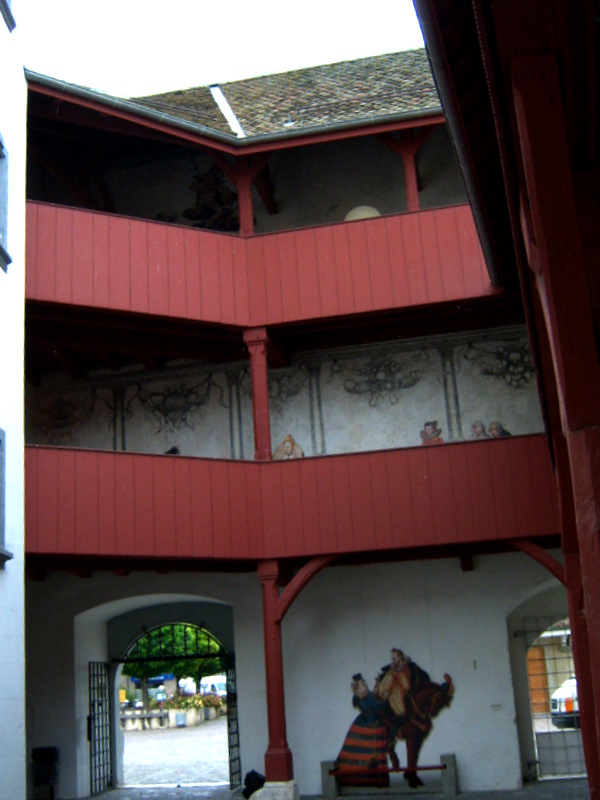
Showing posts with label Switzerland. Show all posts

Saturday, February 25, 2012

Yverdon-les-Bains: Heinrich Pestalozzi, Educational Reform.

Yverdon-Les-Bains
19th Century Educational Reform
Heinrich Pestalozzi
Yverdon:  Spa and a Castle Academy
.
.
From 1805 to1825, the Savoy Castle at Yverdon-les Bains, was used as an educational institute, set up by Heinrich Pestalozzi, reformer. It houses a museum now. Even since that time, it was used for a school in various ways up to 1974.
.
His educational method was structured: move the student from the simple to the complex.
.
Start with observation, then consciousness, then speech, then measuring, then drawing, then then writing, then numbers, then calculating. The whole person. See the ups and downs of Pestalozzi and his method at http://www.nndb.com/people/730/000097439/


Friday, July 16, 2010

Geneva - Founts of Water and Theology. Tall and Wet , to Deep and Dry

From the Tall and Wet to the Deep and Dry.
Geneva Offers Both, but Humorlessly.
I. Fountain Jet at Geneva
Tall and Wet


This is the tallest fountain in the world. Hoo, thought we, but we did enjoy a fast and legal parking spot (still, watch for the meter demon, and take no chances) and a stroll by the water at Lake Geneva. Get a fine overview of Geneva at ://www.geneva.info/ The fountain is a drive-by attraction, broadly visible, and no real need to get out. So we aimed for the Old City, and found an unexpected hassle to find a parking lot there.

Why is the Old City not better marked for tourist cars already in the downtown, and going in ovals and circles and trapezoidinal helixes with the one way boulevards and other turns, and yearning to breathe free by finding the right access street to find the history. And once in some big underground garage, there is a goodly walk, and it is hard to keep bearings. Not car-friendly, and the Old City is elusive. Hard to hone.

II. Theology at Geneva
Deep and Dry
Oh my.


Geneva,  like many modern places, has an odd, disembodied relationship with its religious past.  Here are the Great Reformers, in an outdoor park, Le Parc Bastion, and the geneva.info site does not even name them.  We will.  May we introduce, here at the Reformation Wall, ://www.sacred-destinations.com/switzerland/geneva-reformation-wall.  The task was re-forming Christianity from the elaborately constructed Roman Catholicism it had become, to another, less dogmatic, less riches-focused, etc. form, while demanding deep sacrifice in fluff. Is that so? What happened then?

Guillaime (William) Farel, First Preacher
John Calvin, Leader of the Reformation Movement, see ://www.wsu.edu/~dee/REFORM/CALVIN.HTM
Theodore Beza, who succeeded Calvin
John Knox, friend to Calvin, and the founder of the Presbyterian Church in Scotland

This is very austere stuff.  Here is an advance look at St. Peter's Cathedral, once Roman Catholic, then purged of most of the fancy, and Protestant. From one extreme to another. Both, and a mid-ground, unstable against those who foist.


Sit. Up. Straight. Don't make me tell you again. Hiss.

Thursday, July 15, 2010

Geneva - International Red Cross and Red Crescent Museum

The International Red Cross and Red Crescent Museum in Geneva is sobering, inspiring.  The organization addresses not only natural disasters and wartime, but also ongoing political issues, such as treatment of political prisoners, prisoners of war.


Focus exhibits change every few months.  The photographs, vignettes, settings, show the vast reach of the services.  See ://www.micr.ch/index_e.html/  No organization will be perfect in reaching all it is intended to do, and using funds without reproach, but this one is filling a gap no other group touches in scope.


Note the slogan:  "Our world is in a mess.  It's time to make your move," at the ourworld-yourmove.org banner at the Museum.  That is the organization for the International Federation of Red Cross Red Crescent Movement. The message is to start with simple gestures; don't wait for the big one to be stepped out and unrolled by others.  Individuals count.


1919 - just after WWI.  The International Federation was started.  American Henry Davison proposed forming a federation, after the war years of highly successful activity by a number of humanitarian groups. The first post-war focus was improvement in health for people in the torn nations. There are now 186 member societies, after the first handful.

But it was a Swiss, Henry Dunant, in 1859 who began the idea itself, after a specific battle, the battle of Solferino. See ://www.ifrc.org/meetings/events/solferino/dunant.aspHe organized local inhabitants to treat wounds, feed and clothe the soldiers. An international committee was formed, also with Dunant, in 1863.  See the history at ://www.ifrc.org/who/history.asp/

The American Red Cross:  see its work and the global network at ://www.redcross.org/portal/site/en/menuitem.d229a5f06620c6052b1ecfbf43181aa0/?vgnextoid=a43ff9ae2b4ab110VgnVCM10000089f0870aRCRD&cpsextcurrchannel=1/  Get practical with the disaster response laws, at ://www.ifrc.org/what/disasters/idrl/

Juggling options.

We thought we would park between the Red Cross Museum and the Palais des Nations, the United Nations Conference Center, see the nice Google map here, and how logical it is to park on the nice road between, instead of the parking lot all the way over to the bottom right.  So we did, but the time to do the UN is too long, over two hours, and we got a not so nice ticket.  Switzerland does not know how to do credit cards to pay for les infractions horribles, so you have to do an expensive wire transfer if you don't have an extra day to find out what to do.

Sponsored Links
Advertisement

The International Red Cross and Red Crescent are across from each other.


But, if you are pressed for time as we were, skip the UN in Geneva (takes too long, security measures are understandable but stifling, and groups plod) -  look up photos of the UN conference room and fine murals, and enjoy the grounds but go instead to the Red Cross and Red Crescent Museum across the street.

Thursday, July 1, 2010

Geneva - The UN. Secretariat Building, European Headquarters. Le Parking Ticket.

United Nations European Headquarters
War and Debate Issues Made Visual
Secretariat Building

The Three-Legged Chair.  Landmines maim, kill, but for some, a life goes on.  See the three-legged chair at the entry area for the UN in Geneva, symbolizing the movement against anti-personnel land mines, the ones you step on. Once.

The idea of the chair: Paul Vermeulen, Handicap International, Geneva. Creator of the chair: sculptor Daniel Berset.


Originally, the chair was erected in 1997, to support progress on the Land Mine Treaty, see it at ://www.icbl.org/index.php/icbl/Treaties/MBT/Treaty-Text-in-Many-Languages/English/  It went into storage a while, now is back.  Who has signed? 152 countries.  Who has not?  42, including the United States.  See ://www.thewip.net/contributors/2007/05/a_chair_can_be_a_powerful_symb.html/  What makes the news more than this?  BP may be corraling and burning sea turtles as it burns off oil in the Gulf, see yes, that is important, see investigation and lawsuit at ://www.bloomberg.com/news/2010-06-30/bp-killing-sea-turtles-in-spill-containment-burns-activists-suit-claims.html/.

But so are the some 15,000 children a year who step on land mines, even in countries not at war, where the things remain sub-grass, or in-toy.

Logistics in visiting the UN. 

There is a parking lot, but it looks like overkill if you want a quick visit, see ://www.unece.org/meetings/practical_information/2010_Practical_Guide.EFR.pdf/.  There is also street parking but beware.  You may pass the big lot hoping to find one that you can be in and out of faster, and cheaper, but then can't find easy way back around, and instead you see a space. So you street it.

The  book says the tour takes an hour, but you plan to go faster. Then you find it takes an hour just to get through the reception-identification-phototag not-quite-strip-search maneuvers, then more time to wait for a tour in your language and yes, you have to go by tour; and then the tour itself.  You've lost nearly a morning. And the walk back to your car takes more time, and voila. Un billet du Monstre aux Affaires Criminalistique Touristica!  See FN 1


The main conference room.  

Very impressive, but somehow at this UN you see no women among the dignitaries.  No women in the pictures of famous groupings of problem solvers.  There must be some, but clearly not given prominence in the OPTICS.   Is that why the UN has been criticized for posturing, ineffectiveness? 


The murals.  These are thought-provoking and moving. There are many of them.  See a photostream at //www.flickr.com/photos/un_photo/with/3312371228/  It takes time to absorb, focus on each element, figure, idea. That is the reason to take a picture. The guide keeps moving, and you have to stay with the guide. You. Have. To. Stay. With. The. Group.


Why do all of these now remind me of what it was like to cope with that parking ticket. See FN 1. And don't get us going on concealed landmine pay-go stations invisible invisible around the corner. Was there one anywhere? We looked!  Pay-go is excellent, but too widely spaced. Sometimes far around the corner from the street where you are.


There I am, in that mural up there, lower right.

The grounds.  The grounds are a fine set of walkways, views, places to meander and relax. There are xhibits, display signs. Peace monuments. This is Japan's. See more at ://peace.maripo.com/y_1950.htm/  Read the tributes to Hiroshima at ://www.chugoku-np.co.jp/hiroshima-koku/en/special/index_20070820.html/.  There are peace bells, peace gongs, around the world.


Geneva Swiss Police and Hertz can't work out how to take a credit card for a parking ticket.  Is this for real?
GONG.
.....................................................................................................

FN 1  

Le Parking Ticket Theatre Farcicale. 

There be ironies. You are in Geneva, money country of the world, where gnomes squirrel away billions under the sidewalks, and they won't let you pay a parking ticket by credit card.  If that weren't so pathetic it would be funny. Switzerland?  Switzerland!

You know you need to pay your $40 parking overstay, but see what happens. We were flying out the next morning and the ticket gives no place for your credit card info and simple mail-back. You have 30 days to pay, so you send your $40 in leftover Swiss Francs and Euros with proof of mailing but those obviously disappear in the mail room (don't even try).  So you contact the police and ask to pay by credit card. If you do a wire transfer, as they request, that is another $30-35.  So try to process the credit card. Hertz has properly identified you as the ticketee, no problem, but they add 40 Swiss Francs plus 3.05 VAT for the courtesy.  And keep doing another bill, and another, all for that so-called administrative fee. You ask again to use your credit card. Hertz says they can't do that. And send another bill.

So you call the police at Le Parking number they give, to ask them to take your credit card, but you can't understand the string of words that trill on after the Bonjour, and then get put on hold. Add to your bill the cost of an international call. While you try to get someone to understand how credit cards work, the 30 days goes by and another $30 penalty is added for failure to pay within 30 days.  That takes another $30 wire transfer. And Hertz charges you 43.05 Swiss Francs for notifying you as their costs per month.  So you ask them please just use the credit card they already have. 

No, this is Switzerland, and we don't do credit cards?

Solution: 

All they have to do in the Geneva police and Hertz is put in a place on the ticket-return for your credit card information. You authorize that payment as soon as you get it at home, for the amount and the charge origination.  You can call your credit card company and authorize it, and when it comes through, then you change your card number to be safe.

Of course, then Hertz (they keep notifying you) can't collect the administrative fee of 40 Swiss Francs plus the VAT tax of 3.05 Swiss Francs more. Look what they get by obstructing means of payment - the  fee they add to their notices to you, on top of the Geneva parking amount and then the Geneva penalty after 30 days and 30 days etc.

But why is Hertz even sending notices?  All they need to do is give your name and address, which is fine, and appropriate, and then let the police do their jobs by the police letting you pay by credit card.  No, Hertz wants a fee of several Swiss Francs each time they send a notice.  This is ridiculous.

So:  Parking gnomes?  Voici le plastique!  Geneva. Is anyone listening? We know some French but not a lot. Try this. C'est le moderne methode de payment.  Le credit card.  Le. Credit. Card. Again?  Geneva.  Voici le moderne methode de payment.  Le ....  Oh,  X@#!X*

The International Conference Center, see ://www.cicg.ch/en/  Will all those who want to go to war with Geneva's police department, Le Parking Groupe,  please meet on Monday and get back to all renters who tried to pay with credit cards and are told no.

Monday, June 28, 2010

Nyon - Sights, Chateau Up and Rive-side Down

 The Sights of Nyon

Nyon, you have a lovely castle.

This is a small chateau town.  In the 13th Century, Counts of  Savoy began building their castles, and the one here is built atop Roman ruins.  See ://www.myswitzerland.com/en/destinations/resorts/holiday-destinations-in-switzerland/nyon.html/ 


Start uptown, for the view,


 At Yverdon-les-Bains, where there is another Savoy castle, we learned that the Savoys liked the square format, and some calling it the Savoy Square. The shape lends itself to various performing arts events.


No-one could easily creep up unseen at this towering site. Now there are nice walkways.


This is a nearby large house (when does it become a chateau?), see it to the left of our top photo, where the eye immediately goes to the Chateau de Nyon, all white. Time for this one to come out of the shadows. Not everyone has replastered and whitewashed.  Good.  We like the ones that show some age.

Get a full walk-around show on Nyon and its streets and buildings at ://www.dpeck.info/nyon1.htm/


Take the elevator down.


You can also walk the winding way back down to the riverfront area, the Rive. That is where our little hotel was, bless it.

Look closely as you walk the rest of the way to the riverfront, and find Roman ruins - there, a structure, a part of wall. Some columns. Julius Caesar established the colony here and called it Noviodunum,  after he had finished with his conquest of Gaul.


Wednesday, January 13, 2010

Murten: Heraldry, Gates, Sgraffito

Walled City - Murten
Heraldry, Gates, Sgraffito


1.  City gates.  The entry ways show the depth of the walls. The walls are not always freestanding. Here, there are houses and businesses abutting, even part of it.  See the slant back at the facade of the building just through the gateway - its own kind of buttressing.  Many city walls have a second line of defense past the main gate, before entering the city: a second huge door, or iron portcullis to drop down the slots.  Some have a murder hole above, where defenders can rain down arrows, pitch, on those stuck in the midway before getting through to the town.

Note that an invader has successfully passed through and is waiting for lunch.


Murten, Switzerland, city gate with heraldry

This gate is sectioned into the big swinger, and then its own little door with its own little window - allows the watchmen to let one person in without the vulnerability of the entire gate opening; and the little window to check identities.  No body scanners yet.

2. Heraldry.  There is a heraldry motif on this gate to the city of Murten:  See  a red and white wavy line pattern, seen also on shutters, doors.

Look up heraldry to see meanings, if any. Or it is just personal taste spread about. The white (also silver, or "argent"), according to://www.fleurdelis.com/meanings.htm/ means peace and sincerity; the red ("gules") means "Warrior, martyr; Military strength and magnanimity." A wavy line means water, sea.  Fine:  this city knew many sieges, and it is on Lake Murten, or Murtensee.  The site also notes, however, that there is no one interpretation of any of this. 

3.  View from inside the city.  Here is the other side of the gateway, looking back at the tower and its warning bell, and a cafe next door.

There is ornamentation known as "sgraffito" on the cafe built into the wall, visible from the inside. 


4. Sgraffito.  Sgraffito is a multiple-step decorative process, where one color of pigment is covered with another; sometimes a layer of plaster will be covered with another layer, then the top one is scratched deep enough to reveal the contrast beneath. See entire pictures on buildings; or designs that can be made to look like stonework, ironwork. Do an images search for sgraffito technique.

5.  Clockworks

Saturday, December 12, 2009

Spiez Castle, Lake Thun, Switzerland

Spiez, Castle at the Town on Lake Thun

The castle complex here at Spiez is located for maximum views of the lake, mountains and countryside. The castle itself, here (see the church at another post) shows the transition from defense to residence, old tower, later stately mansion. Rooms originate in the 1200's through the 1700's, but the castle itself dates from the 10th-11th Centuries. Fortified colonies here date to 1000 BC.

The name:  More Celtic connections - the name of the town came from the Gaelic word for corn, says this site. See ://www.swissqualityhotels.com/hotels/Switzerland/spiez/about.asp?_lang=en/ *

* Corn? We thought that crop was North or South American?

Spijates and Spiez.  The word is "spijates". Have to look that up.  Just did.  Can't believe all you read. Spijates here is defined as "thorn" and not corn at all.  And it is indeed Celtic, not Gaelic. See http://www.epinions.com/review/trvl-Dest-Europe-Switzerland/trvl-review-7D6D-9EC060-394B064F-prod1/  Isn't Gaelic later than Celtic?  Yes. Celts were all over Europe before being shoved into the British Isles, and finally the remotes of Ireland and Scotland. See their history at ://www.ibiblio.org/gaelic/celts.html

For looks at the relationship of Gaels and Celts, see ://www.ibiblio.org/gaelic/  There are six languages in the Celtic group. Gaelic is English for a cluster of three of them:  the Irish, the Manx, and the Scots.


The tower is Romanesque with 13th Century Graffiti, we now learn, but did not see.  Is that it above the window, preserved? This site calls it medieval castle with baroque style, but that can't be right.  Centuries separate medieval from baroque. Fine to say originated as medieval, later redecorated in baroque.  See //www.interlaken.ch/erlebnisse/sommer/kultur/schloss-spiez.html?L=3

Tuesday, December 8, 2009

Castle Thun, Schloss Thun, Switzerland

.
Thun Castle was built in about 1195. Celtic tribes had lived here until their defeat in 58 BC, that defeat beginning in France with Roman victories, and then extending to Switzerland. The Celtic lands were vast, and culture was longstanding, but they left no written records. Their word for fortress, something like "dun", or "dunum" at this site, became Thun. See ://home.att.net/~long.hair/steffi/thun/thun.html/


The Romans were pushed out in about 400 AD, Irish priests came and converted folk in the 500's AD and then two groups battled it out:  the Latin-speaking Christian-Burgundians; and the German-speaking Allemani. Enter the French, after a time of this and that with the Charlemagne group, and more centuries of jockeying. See the steffi site above.

Locks, door to prison in tower, Castle Thun, Switzerland

The dynasties and fighting would take pencil and paper and a graphic outline and time line to absorb. Ultimately, Bern and the Germans assumed a greater role in governing the area.

Thun, Manacles, prison in tower, Schloss Thun, Castle Thun, Switzerland

In 1322, during an inheritance dispute, one royal brother, Eberhard, wounded his competing royal brother, Hartmann, and had him hurled from the parapet. See ://home.att.net/~long.hair/steffi/thun/thun.html/.

View down, Schloss Thun, Castle Thun, Switzerland. Brudermord from here?

Brudermord. The Brother Murder.

Enjoy this site for more photos, see ://www.tompgalvin.com/places/ch/thun.htm/.

Thursday, December 3, 2009

Minaret ban, Switzerland. Height; and Vista Preservation; not Xenophobia

Articles and comment about the Swiss ban on minarets.  These can be really high.  Here is one, a mosque with its minaret on Gibraltar, the minaret at least double the height of the mosque below.
.

The articles against the Swiss ban on more minarets focus so far, mostly, on outrage: that Switzerland would restrict how people worship; that it is intolerant and closed.  See overview at the Harvard Law Review, at ://www.hlrecord.org/opinion/switzerland-s-minaret-ban-about-more-than-xenophobia-1.951293/  Does the Swiss ban really signify a high degree of fear and uncertainty. No.  It is pragmatic.
  • Pragmatism.  
Minarets are no more necessary to religious practice than steeples.

Focus instead on the pragmatic impact of minarets on the practice of the religion.  Is it necessary.  No.  No more than our steeples are. What role does the minaret really play in the practice of the religion: it is no more symbolic than a steeple is. And the practice can go on without it. See role of the minaret at Swiss Minaret Ban, Narrow Tourist Vista Purpose.

Minarets do impact negatively on the tourist industry on which Switzerland substantially relies. How about the pragmatic impact of the proliferation of minarets on an industry on which Switzerland relies:  the tourism industry, the photographic opportunities, the lure of pretend.
.

Interlaken, for example, is more Eastern-Indian-Other foreign than Swiss, it appears in walking about, and the experience is just that: global, great food, international, but not "Swiss" if that is important to you.

This idea of preserving the history, the tourism (that brings in money) also applies to Austria, and Northern Italy, the other angles of this most recent regional trip. Our photos and desire to return depend on fantasy. Is that worth preserving? Maybe not.

What if there had been minarets or other religious symbols dotting the landscape above roof level at Castle Bruck, Lienz, Austria;

.
or Turin, Italy, a city with a vast eastern and middle eastern population - just follow the trolley lines to the center, and go through vast markets.
  • Fostering some "Pretend" in our lives
People make all kinds of things up to get by. Religion and romance and regret (the real Three R's) are full of it.

The "Pretend" involved here, in this minaret issue, is that you live or lived in this castle, yodeled on that hillside, were watching Heidi, or learning of William tell, or there when the Romans were, at Avenches or other places with Romans in Switzerland, or you were in a medieval canton, a renaissance or baroque church as it was being constructed.  I am a princess, yes, I watched from this window as my knight rode ever nearer.  Nuts, yes, but fun. Disney is made of fantasy.

I may well have had my own armor, yes, I did.  Take that, you stereotypers.


  • Promoting photography, scenic vistas.  Would we have taken this picture or that, if there had been a minaret there.  
 Probably not. Minarets are counter-old history. They are modern amalgamation symbols in modern countries with diverse populations.  Switzerland is modern and a mix, but its broad ethnic diversity should not hinder its tourism industry that profits on the old.

So: as tourists, we would have tried to move to another angle if a minaret had appeared in the lens, to avoid the intrusion of another culture's modern symbol when we were indulging our fantasies, much as we also avoid power lines and tour buses and Big Macs.
  • Xenophobia?
Fear of the new, different, strange to oneself? See ://www.merriam-webster.com/dictionary/xenophobia/

Not necessarily.  We see banning minarets as a desire for the experience we paid for:  the imagination, the fantasy, the beauty of the old scenes, untouched by the modern. Learning history. Is that worth anything? Maybe not. Maybe the new economic order (why don't steeples get allowed in the east?) makes minaret construction necessary. Are they needed to worship? No.
  • The minaret, to the West, means Our Failure, Mistake, Blunder with Repercussions Centuries Later
Think of it.  What do minarets really mean to our Western culture?  Failure. Ours. Failure. Our failure.  The Crusades were the biggest religious, theological, political, and humanitarian mistake of that era.

.
We are still living the Crusades' repercussions. Minarets as symbol.
  • Resolution.  
 So, why not allow new minarets at a height and in a location that will not disturb the photo-scenery industry - that is pragmatic - and no more until there is an exchange: western people's steeples can shaft as high in eastern and middle-eastern lands as they would have minarets shaft in the west.

Fair and balanced. Use zoning, height limits, placement, and a tourist's perspective if you want that. Ban entirely, okay since a feature of architecture is only that.

History-fantasy. That is what tourism thrives on. Why not. The minaret, the steeple, don't overblow what either means.

Sunday, November 29, 2009

Chillon Castle Santa. Black Madonna. Heraldry on Walls. And Religion on Ceilings.

Finding Santa Claus, and a Black Madonna, in Unexpected Places.
Chillon Castle, Lake Geneva, Switzerland

Join a tour, have to keep up. But, if you go on your own, you can stay as long as you like, and find things. Here, start looking at frescoes, wall and ceiling paintings, and heraldry. Some things bowl you over.

A. We found Santa Claus.

Yes. He is not at the North Pole.  He is on Lake Geneva, Chillon Castle heraldry room, confronting a big black bear -  possibly a Bern image, but what about Santa? Or is that a black dragon?  The heraldry Griffon, perhaps, also spelled "Griffin" - see ://www.isidore-of-seville.com/griffins/9.html/. Or Gryphon.  There are littler cute griffins or gryphons showing below, black against red griffins there?  Who prevailed:  it looks like the red griffin is bottom up. It looks like waves around, or big winds, black and white again and the red Santa. For heraldry, start at ://www.heraldicsculptor.com/heraldry.html/.

Back to Chillon:  Find a clue:  "Frederic de Gingins."  Who? This is really odd.


First, Santa:  No clue from our fast look-ups. But it is there. Hoax?

1.  Frederic de Gingins as Baron de Gingins, whose name apppears beneath some unusual (anachronistic?) heraldry in the heraldry hall at Chillon Castle, Switzerland.  He is in a google book now, at "Historic Studies in Vaud, Berne and Savoy; from Roman Times to Voltaire, Rousseau and Gibbon" by an English General Meredith Read (family connections to America, Virginia; Civil War era accomplishments noted) at ://www.archive.org/stream/historicstudies00readgoog/historicstudies00readgoog_djvu.txt/  This is full of Gingins references - skimmed for Santa or a Saint Nicholas or something, did not find.  But long long history of Ginginses.

All that is fine, but when and why and how the Santa? As a Vaudois nobleman, he is listed as Frederic Gingins-La-Sarra, 1790-1863, or La Sarraz (see Author Index at ://fmg.ac/MGR/Indices/Sources/Authors/Links/G.htm/), a historian specializing in medieval times who sometimes went beyond his documents to make something what he wanted it to say, see ://1911encyclopedia.org/Switzerland/. Antoine-Charles de Gingins.  Ancestry.com has an 1859 geneology you can order. Is Santa home? Part of the Sires de Montfaucon comtes de Montbeliard.   

2.  There is a "Christmas Market" in Montreux, town just down from Chillon Castle (is it in Montreux?), but that looks modern, but then again so does this odd Santa, see ://switzerland-travel.suite101.com/article.cfm/visit_the_romantic_montreux_christmas_market/  The heraldry is a hoax? Ok. Here is a long history of Switzerland: at ://1911encyclopedia.org/Switzerland/ No mention.

3.  This is not St. Nicolas of Myra, patron saint of children, see ://www.civicheraldry.co.uk/ecclesiastical.html/ and there are no ecclesiastical hats or flock hooks here either. See also ://www.civicheraldry.com/page/7297/  Swiss civic heraldry is indexed at ://www.civicheraldry.com/region/switzerland/ Have not been through them all.

B.  And a Black Madonna at Chillon.  

We found a Black Madonna. This time, up high.


We have seen free-standing paintings of Black Madonnas, and statues.  There are many, and varied in explanations and places in Europe, and, we understand, elsewhere in the New World.  See, an outdated, but good for a start, our collection at an earlier time at Europe Road Ways, Themes, Black Madonnas. 

Here we find our first Black Madonna painting on a ceiling, a ceiling fresco, or, perhaps, it is just a painting there.  Fresco, on the other hand, is a special technique, that means painting on wet plaster so it lasts a long time - we don't know which this Chillon ceiling painting is.  Fresco:  see the Italians who were especially good at it, at  ://www.italianfrescoes.com/frescoTechnique.asp.

Here is the Black Madonna we found at Chillon Castle:


What is the history?  We cannot find it. But there are many other black figures at Chillon, and black-white motifs. Being researched. We see reference to a Madonna da Vico at ://www.archive.org/stream/santuarioofmadon00rossuoft/santuarioofmadon00rossuoft_djvu.txt/, but an Images search of Madonna of Vico shows nothing like this.  Even Dorothy Dix in 1926 makes no mention of this in her travel journal from the US to Eastern Europe, this part at Chillon, see ://library.apsu.edu/dix/lettersanddiaries/diary1926.htm/.

Comment, approach audience from stage: Are we at the point in travel like, with news, all we can get is people's rehash on tours of what someone else said or did. Look at fact content anywhere.  Where are facts. Nowhere to be found.  We get opinions and views in place of news, and in places that are labeled "news" and aren't p they are opinions and propaganda.

Nuts. As with art. Where are the facts.  Here, in art, same thing. We get tours with see this, see that, and the people do, click the same pictures, and leave.  What about all the rest?  The things that are there, but ignored, and who knows what they are. Enough. Somebody pick up on these, however, because they are fun.

Wednesday, October 7, 2009

The Moor Motif in Switzerland - Origins. The Blackamoor. And Saint Maurice.

Black and white. Not unusual in itself as a motif for coats of arms, but we are interested in the extension of it to the Moor motif we saw in several places in Switzerland.  Our conclusion so far is that the Blackamoors in Switzerland related to St. Maurice, a man of dark skin, but not possibly a Moor because he lived in the 3rd Century, and Mohammed did not arrive until the 600's.  There were no "Moors" in Maurice's time.  Nonetheless, Maurice morphed into a Moor, possibly as the slave trade demanded that blacks be shown in servitudinous garb.  He had been in a higher role, serving as patron to various trades, but without the Moor garb. Follow as we try to figure things out.

Summary of issue:  St. Maurice lived in the 3d Century, leading a Theban Legion (Thebes, Egypt, Africa, black?) under a Roman Commander.  The Commander ordered an attack against an enemy, we understand, that had Christians in it.  Maurice (Moritz, Morris) was Christian, as was the Legion of some 6000+ soldiers, apparently from Thebes, and all black or Egyptian dark perhaps?

Maurice refused to kill Christians, the Commander insisted, and perhaps began to decimate the Legion (kill one of ten), and ended up killing them all for refusal to fight against Christians.   Is that really martydrom, or just disobedience of military orders, discipline, also in there.

The point is that none of these Legions or Maurice himself were Moors - Mohammed was not born until the 7th century.  How could Maurice be a Moor when Muslims did not evolve until three hundred years later?

History.  A mess.  Illogical, but beliefs persist. So we have Maurice now portrayed as a Moor, perhaps a result of the post-medieval slave trade, where blacks were to be in their place.  Is that so?
.

And retain your own option to choose what to believe.  As a Third Century soldier-saint, for example, Maurice as a Black Moor would not have worn this outfit, but the Blackamoor is dubbed with it, perhaps influenced by the Renaissance-Reformation era form of slave trade and monarchies obsessing about roles and threats. Symbolism and cultural fancy win over fact every time, even in theology.
.
So, see black and white  1) as a pattern, and also, 2)  in human form, as The Blackamoor.  Find Saint Maurice; and other roots leading possibly to  a) Prester John (of legend, but also some fact rootings); b) Roman Catholics vs. Reformists; and  c) back to the Bern cloth guild's use of the Blackamoor as a patron saint of a weaver or clothmaker guild. Then go back further to  d) Sardinia and Corsica. See their coats of arms; with a Black figure head, and different traditions from the Blackamoor.  The roots here are spread.

Wikipedia, that overall orienting source, lists the origins of St. Maurice as the Black Moor, see ://en.wikipedia.org/wiki/Saint_Maurice/  Apparently there is a carving at the Cathedral at Magdeburg, Germany, from 1240 showing St. Maurice as a Moor. See also Maurice as Egyptian.
.
.
A.  So far, we have found these depictions of Moors in Switzerland:


A.1.  Bern. 

In Bern, there is a statue of a Moor, installed as other statues in the street, at the second story level of the buildings.  The Moor represented the cloth guild. See Statue, Moor, Bern.   Bern is in the German-speaking area of Switzerland.


See St. Maurice (St. Moritz) discussion below - is this really St. Maurice.  Note the spear in the Moor's right hand the Holy Lance of Vienna, one of the relics said to have pierced Christ's side?  See that at ://en.wikipedia.org/wiki/Saint_Maurice/. With Wiki, reliability depends on the contributor, but what else is that spear?

Demotion to a cloth merchant??  Not necessarily. As a patron saint of many things, including soldiers, armies, swordsmiths, dyers, and so weavers are just one of many, including against menstrual cramps, says Wikipedia at ://en.wikipedia.org/wiki/Saint_Maurice/ A man of many trades.
.
Or is it the Spear of Destiny that St. Maurice carried into battle.  See same Wikipedia site.
.
A.2.  Avenches.

We also saw a Black figure, a face and head, in Avenches, a Roman-origin town in the French-speaking area.

Look to the right.  There is a banner, and there were many of those banners around, showing a different figure from the cloth guild, but Black, and it even looks like a slave.  Or is it? There is a headband. We asked a waitress about it, and she had no idea.
.
Avenches, Moor, motif, associated with banner: liberte et patrie, Switzerland
.

This looks like the Sardinian-Corsican form, see below. If the pattern goes through the cloth, then from the other side, the face would (obviously) be reversed, and look like the Corsican one.
.
A.3.  At Chillon Castle, Montreux: 

There is what appears to be a Moorish motif on the ceiling, religious figures perhaps, on a coat of arms, camera slipped.
.

.
B.  We looked up The Blackamoor in Heraldry.

B.1  Familiar to us already is the "Blackamoor" idea, as in Othello.
 .
The Moor in Renaissance literature is highly intelligent, a full participant in the society.  Look up this source:  Many coats of arms showed a Blackamoor motif in the 13th-15th Centuries in Europe.  See Frontline,  Sigillum Secretum (Secret Seal) on the Image of the Blackamoor in European Heraldry, at://www.pbs.org/wgbh/pages/frontline/shows/secret/famous/ssecretum.html/. The author is Mario de Valdes y Cocom. This is a site with all the positives of the traditions of the Blackamoor.
.
B.2  Blackamoor in Avenches. 

Look back at the Avenches banner with the Black man's head, and the white angled headband. It resembles the Corsican-Sardinian Moor, not the Shakespearean Othello or other Blackamoor.  Should we distinguish from Moor and Blackamoor?
.
B.3  Blackamoor in Sardinia. says the site. That same head, in reverse, appears on a coat of arms from the island of Sardinia, and in four separate quadrants, with a cross separating them. Here is Sardinia's symbolism with the four Blackamoors.
This fair use from ://en.wikipedia.org/wiki/Flag_of_Sardinia
 .
There are traditional explanations, serving the interests of the white Christians, and then there are ones emerging historically.  Read some at the Wikipedia site. Then keep going. For example, a traditional white explanation is that the four heads represent four emirs, muslim leaders, defeated by a king of Aragon, Spain, in the 11th Century. From this idea grew another:  that the figureheads represent evil, the things to be overcome. Beginnings of racism, perhaps.

Blackamoor in Corsica:  See this one - from the mid 18th Century, see ://en.wikipedia.org/wiki/Flag_of_Corsica/


.
B.4  The Blackamoor himself:  Was it St. Maurice. St. Moritz.


Is St. Maurice Roman Catholic, or Coptic?  Does it matter?? His story was laid out by one St. Eucher.  He was Bishop of Lyons, France, in 494 AD.  See site ://www.copticchurch.net/topics/synexarion/maurice.html
.
The historical research, however, suggests that the head is not a negative precursor of racism, but represents a saint, a Christian saint, Saint Maurice.  Maurice was the patron saint of the Holy Roman Empire in the 10th Century, a "soldier saint."  Apparently he chose martyrdom, retaining his faithfulness to Christ, and refusing to kill Christians as Emperor Maximian demanded. He died along with a (isn't this a highly symbolic, magic number? *) number, 6666, of his fellows, Christians from Upper Egypt, see ://www.copticchurch.net/topics/synexarion/maurice.html - his "Theban Legion". PBS says they were Ethopian. Thebes is Egypt or Ethopia?  Where were boundaries then? Either way, the race symbolized Christ's universality.  St. Maurice, the soldier, the armed warrior.

The massacre of them all occurred at St. Maurice, Switzerland, then known as Aquanum.  If that is St. Moritz,Maurice in the German name way rather than the French tilt, then it is the ski resort.

Read at the Coptic site the names and circumstances, including these: There is an altar at St. Peters' for St. Maurice, many churches bear his name (he was new to us) and St. Maurice's lance (see a lance in the Blackamoor's hand, Bern) was bargained in exchange for a Swiss canton. Also read about his sword. There are not separate iconography in the Coptic Church, except in Canada.  Maurice is venerated in the Roman Catholic. For 500 years, a service with chant called Tasbeha has been performed at St. Maurice in Switzerland for 24/7, without stop.

Yes.  Without stop, 24/7 for 500 years, says ://www.copticchurch.net/topics/synexarion/maurice.html/ site.  So,  Maurice and Switzerland.  Clear connects.

Maurice later symbolized the authority of the old Roman church against the reformers.
.
C.  Then we looked up other uses or symbolisms related to Black and White


Black and White and Reformation / Counter-Reformation.
 .
The symbolism of black and white developed in important ways for the Germans, and for the Pope.  Reformation vs. Counter-Reformation.  The concept of the black and the white came to represent the old order versus the reformers.  Luther, Calvin et al.

So, look back at the symbolism on the coat of arms here, at the top, with half the lion rampant in white, and half in black. Reformation, Counter-Reformation. Is that so? All this about black and white representing those two forces is from the PBS Frontline site above.

D.  Other uses of the Blackamoor in Contemporary Heraldry

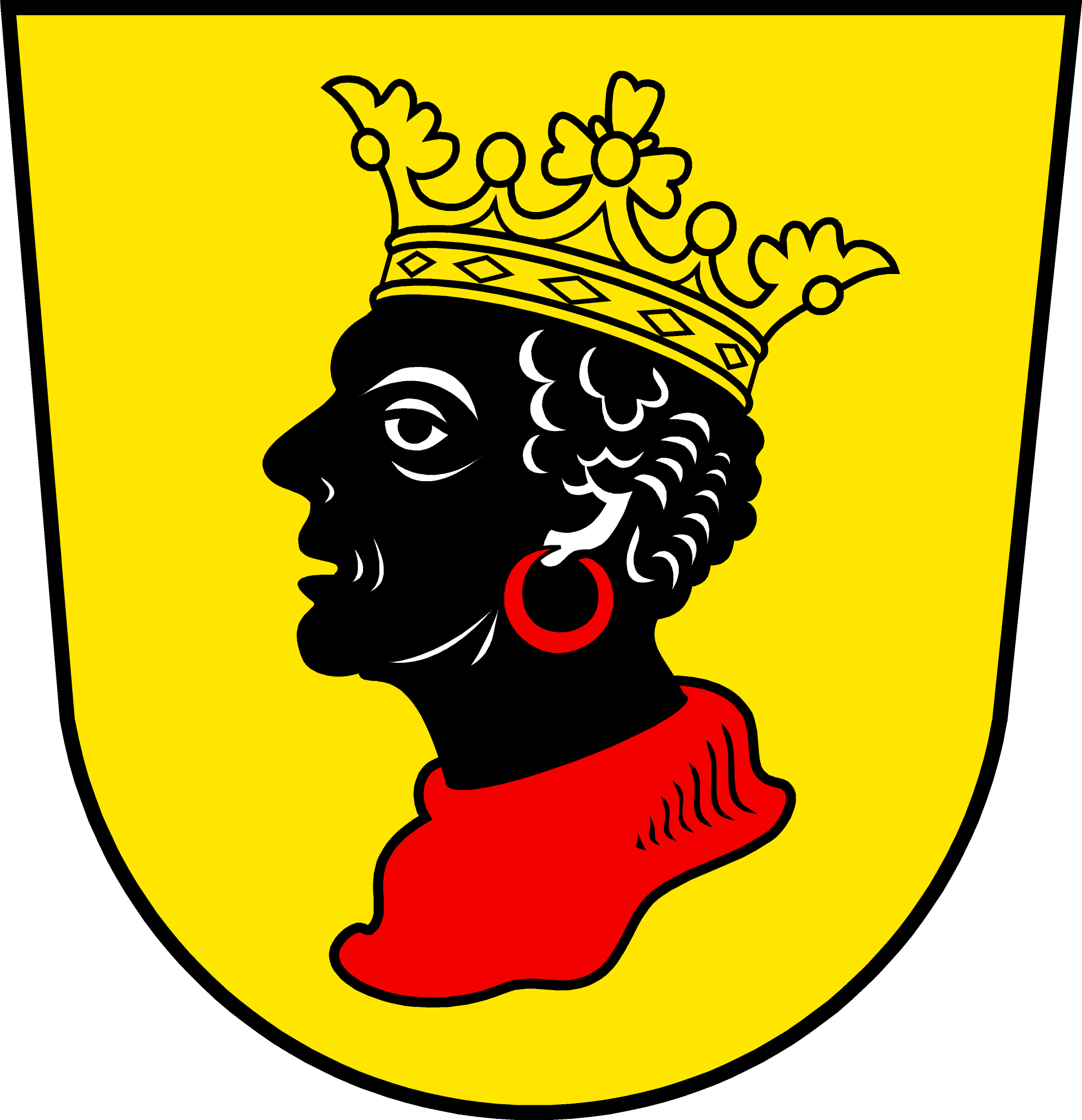
D.1.  Pope Benedict XVI has the Blackamoor, Crowned, on his coat of arms:

This includes the Blackamoor, but a crowned one (allusion to the perhaps not so mythical Prester John?  Or to Saint Maurice?).  This depiction was first on the coat of arms of Otto of Friesing. See ://www.erzbistum-muenchen-und-freising.de/EMF207/EMF020624.asp/,  This is a site of the Archdiocese of Munich.

Here is a fair use copy of the Pope's coat of arms, with the Blackamoor, crowned.  It also has on it the (Bern?) Bear, it looks like; bearing (pun) the burden of office; and the traditional Pilgrim's Scallop shell. It is called "The Friesing Moor" at the site. The "Head of the Ethiopian" is also used on other coats of arms.

D.2. Friesing.

The Head of the Ethiopian is also on the coat of arms of the German district of Friesing, fair use of it here, see ://en.wikipedia.org/wiki/Freising_%28district%29 / Coat of arms
 .
That site, only as reliable as the people putting stuff in, says the head could be saints traditionally known as Moors:  St. Mauritius (Maurice?), St. Sigismund of Burgundy (no connection that we can see, except he was involved with starting the abbey at Aguanum, see ://en.wikipedia.org/wiki/Saint_Maurice), or St. Zeno of Verona, who may have been from North Africa, Mauritania; even St. Corbinian who is associated at the Pope Benedict site with the bear, but the Wikipedia site says the only reason they bring Corbinian up in the context of the Moor idea is that Corbinian's face could have darkened over time.  Lame.

Maurice:  add spellings Moritz, and Morris, and Mauritius. See://en.wikipedia.org/wiki/Saint_Maurice/  Wikipedia's contributors so far call the Theban Legion "legendary."  From legend, or so find that their stuff is worthy of legend?  Wiki?
.
E.   Ideas.
  • Now, if the black symbolized the old Roman church and its teachings; and the white symbolized the reformers, no wonder the reformers were offended at the prominence given St. Maurice, as the PBS site says.  Is that why, in Bern, then, in Protestant Bern, the figure appears as a mere cloth guild "union member" symbol.  Religion idea expunged.  That would be so if the representation did not mean "patron saint of".  Is that is?
So, the practicalities of the marketplace take over 1) if the use of the Saint not as just a Corsican style head as seen in Avenches is rejected; and on purpose, to demean him perhaps, he is shown in Bern as 2) the nearly naked Blackamoor kind. Protestant Bern and commerce, with a religious dig.  Avenches, in the Catholic French-speaking area, retained it as St. Maurice.
  • St. Maurice, the Town:  Switzerland's connection.  St. Maurice of Theba/. See Coptic Church site, at ://www.copticchurch.net/topics/synexarion/maurice.html/  So - Maurice was Coptic. That is its own research into earliest Christianity.  No time here.  
 If it is the same as St. Moritz, the resort, we intentionally passed it by.  Enough of resorts, but we'll go next time to see the Abbey.
Either way, all considered, Switzerland clearly has close ties with St. Maurice. Look again at the town named for him, the contemporary use of the banner.

St. Moritz-St.Maurice is just past Martigny where the Grand San Bernardino Pass leaves us off, after coming from Italy and Aosta.  Famous pass. Historic road. See it at http://images.google.com/images?hl=en&sa=N&tab=li&q=st.+maurice+switzerland/.  It is right there, on the road to Montreux.  At the southern end, it goes to Rome. We must have passed it because we went across that pass (so did Napoleon) coming from Italy back to Switzerland. That site says 6600 of his soldiers died with him.  Not the fateful 6666.  Read the Golden Legend about him at ://www.catholic-forum.com/saints/golden277.htm

F.  PRESTER JOHN.

Fancy flying. There could be another connection.  Prester John was ruler of Ethiopia (legend, or with which facts, as these do not appear to have been checked out much - go back to the East, not just to Ethiopia, as some sites are doing now), and was both priest and king. ruling wisely and in a land that prospered under him.  He came to symbolize, as a Black figure with crown, the ideal state. See ://www.dacb.org/stories/ethiopia/prester_john.html/
 .
Is he legend, partial legend, real, what is what. How impossible is it and was it for White Europe to imagine a Black revered head of state. We are supposed to look up the coat of arms of the see of Friesing to see the motif of the Black crowned king.  It is later on the same site.

St. Maurice and his Legion became associated with Prester John, the ideal, and - here we go, white Christians, the only ones who could claim a bloodline with Jesus because they descended from Solomon. This gets beyond my ken, so go to the site and read.  Only Prester John had the right to carry the cross, the crucifix.  Look at the earring on the Blackamoor - a symbol of that privilege. Blackness as an allusion to God. To Wisdom.

This gets beyond a mere tourist in Switzerland noting themes. FN 1

And all rounds back to the Sardinian heraldry. And now, we see, Corsican as well.  FN 2.

...................................................................

FN 1  For your own research:

The PBS site continues with many possible connections, tracing the tradition of the earring, with the legitimacy of the line from Solomon, and the Black Madonna, noting the earliest stories of the Grail being in Ethopia (story still strong), the Black Wise Man of the Epiphany, Balthazar (later treated as a King), and ultimately the symbolism of sun, moon and six-pointed stars on mythical heraldry developed for the Wise Men. And the black St. Dismas, thief on the cross who recognized Jesus.  These are Christian allusions, Biblical, but they stem not from a religious bent here, but on research about who the Blackamoor in Switzerland represents through these many centuries. Also find the Black double-headed Eagle of Justice,

Jumping ahead, is that connection between the traditions of St. Maurice, and Balthazar, and Prester John and all, an explanation why there is the six-pointed star, the hexagram, "Solomon's Seal", "Star of David", on the roof tiles as a pattern on the church in the medieval city of Murten, also in Switzerland? Experts, on your marks.

......................................................................

FN 2.  More on the symbolism.  There are also negative allusions to Blackamoors, but these appear to be uses of the term as a reaction, to denigrate, intentionally, regardless of historical roots.  See literature at a cursory site, ://en.wiktionary.org/wiki/blackamoor/

A Blackamoor also appears in Scots heraldry, with varying explanations, one being the killing of a black man (like the Sardinian coat of arms once said to represent the conquest of the four emirs); and a reference to Sardinia's originally showing blindfolded figures (at PBS that meant a symbol of justice, not captivity), and later the blindfold is moved up to become a headband, see ://wapedia.mo/en/Blackamoors_%28decorative_arts%29?t=2/. 

The Maur, or Maure:  This is a term for the single head.  See ://wapedia.mobi/en/Maure/.  Does that not sound like Maurice, as in St. Maurice in the PBS account?  But why the Greek and Phoenician origins suggested, without supporting information.

Corsican coat of arms shows the Maure. "U Moru".  But it was a female, blindfolded. Much more there. Clearly, the Moor is not anywhere by accident, but has meanings that by now blend and evade.

Now, after all the fair use thumbnails, meet the man in the public domain: at ://commons.wikimedia.org/wiki/File:Hochstift_Freising_coat_of_arms.png